
At a glance
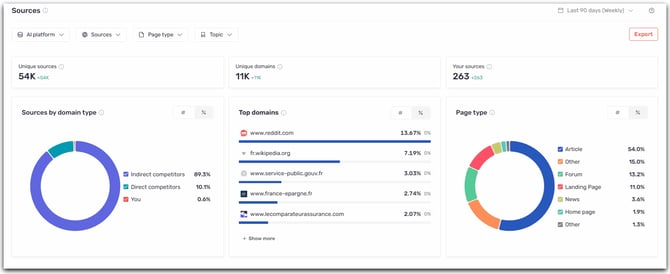
- What you can do: explore the domains cited by LLMs on your monitored prompts, analyze sources by page type and family, and identify the sites most present in AI responses in your sector.
- Who it's for: heads of SEO, content managers, and SEO project leads.
- Why it matters: knowing you're not cited in LLMs is useful. Knowing which domains are taking your place and on what types of content is what lets you act.
What changes for you
Until now, Intelligence Hub GEO told you whether your domain was cited in LLM responses. But there was no dedicated view to understand who was taking your place, on which prompts, and with what type of content.
Before: you knew you weren't being cited, but couldn't identify which domains were capturing those citations or understand why LLMs trusted them.
Now: the Sources view gives you a complete picture of the source ecosystem across your monitored prompts : domains, page types, source families, appearance counts so you can decide where to invest first.
Good to know ℹ️: the AI competitors identified in the Sources view are not necessarily the same as your classic SEO competitors. LLMs cite sources based on their trust in the content, not just Google ranking.
What you'll get
The Sources view gives you four levels of analysis.
- The most cited domains: the list of sources that appear most frequently in LLM responses across your monitored prompts, with total appearance counts per domain.
- Analysis by page type: a breakdown of sources by content type (article, e-commerce page, comparison site, forum, media…) to identify the formats LLMs favor on your topics.
- Analysis by source family: a grouping of sources into families built from detected domains, for a more structured reading of the AI competitive landscape.
- Filters by prompt and AI platform: the ability to narrow the analysis to a specific prompt or a specific LLM (ChatGPT, Google AI Overviews).
How to use it
1) Access the Sources view
From the sidebar, click GEO. The Sources tab is accessible from the screen navigation, alongside AI Visibility and Prompts.
2) Identify the domains capturing citations in your place
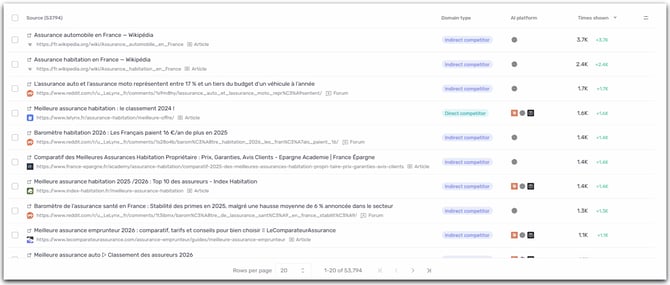
The source list shows the domains most cited by LLMs across all your monitored prompts, sorted by number of appearances.
Identify the domains concentrating the most citations on your strategic topics. These are your main AI competitors regardless of their position on Google.
Tip ✅: compare this list to the SEO competitors you've configured in Intelligence Hub. Domains absent from your SEO radar but heavily present in LLM sources signal an emerging AI competitor worth monitoring.
3) Analyze sources by page type and family
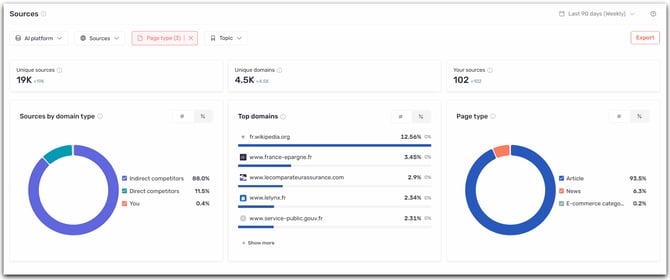
Use the page type segmentation to understand which content formats LLMs favor on your topics: articles, comparison pages, product pages, forums, media pages…
Explore source families to group domains by category and read the ecosystem more clearly. This view helps you identify whether LLMs trust media outlets, comparison sites, or institutional websites more on your queries.
4) Refine the analysis with filters
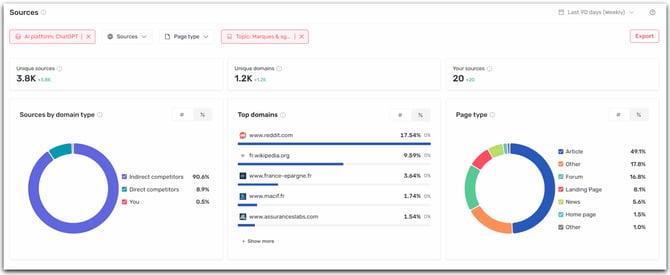
Use the AI platform filter to compare sources cited by ChatGPT vs those cited by Google AI Overviews. The two LLMs can trust very different source ecosystems.
Use the Topic filter to isolate sources cited on a specific query universe and refine your analysis topic by topic.
Tips for getting the most out of it
Start with the topics where your citation rate is lowest. That's where the Sources view delivers the most value: you identify exactly who is taking your place and with what type of content, which directly informs your editorial decisions.
Analyze page types to adapt your formats. If LLMs massively cite comparison articles on a given topic and you don't produce any, that's a format gap to fill not just a topic gap.
Cross-reference identified sources with your content actions. The most cited domains on your strategic topics are priority targets for your optimization efforts: producing content comparable in quality and depth is the most direct path to earning citations.
Tip 💡: a domain heavily cited across multiple prompts is a strong signal. That site is recognized as a reference by LLMs in your sector. Analyze its most cited content to understand what earns it that trust.
Go further
Useful links: