

 Home
Home Getting Started
 Help Center
 Developer
 Status
Why are Search Intents (formerly called Headings) important?
Semji’s Search Intents section shows you what topics your audience is interested in around a given keyword. They allow you to structure in a few clicks a relevant editorial plan for your audience. These search intents are to be integrated in your Hn tags (titles and subtitles) in order to make Google’s crawlers quickly understand that your content is relevant and complete on the targeted keyword. By producing a content structure that is relevant to your audience and to Google, you improve your chances of ranking in the top 3.Search Intents, how does it work?
Integrate users’ search intentions into your text
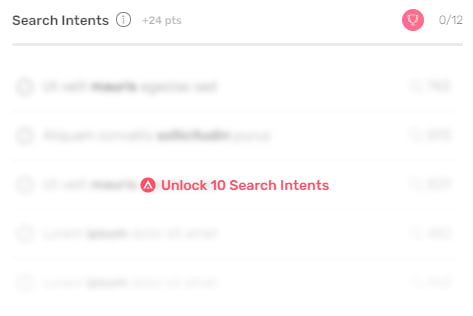
Click on the Search Intents section in the list of recommendations. > If you have a Starter or Pro subscription, Semji offers you to view them using your Search Intents credits (the number of remaining credits is displayed when you click on your profile, in the top right corner of your screen). > If you have a Custom subscription, you will be able to see the recommendations immediately because you have unlimited Search Intents. To decide whether you really want to spend some of your Search Intents credits, see how many points you can earn on your Content Score by including Search Intents in your headlines:

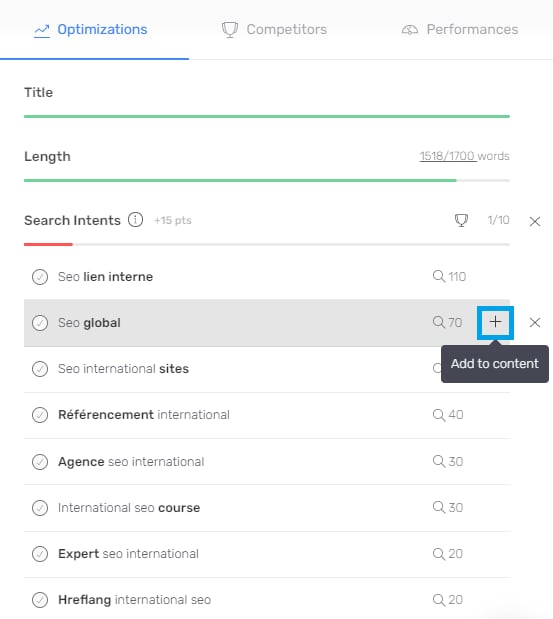
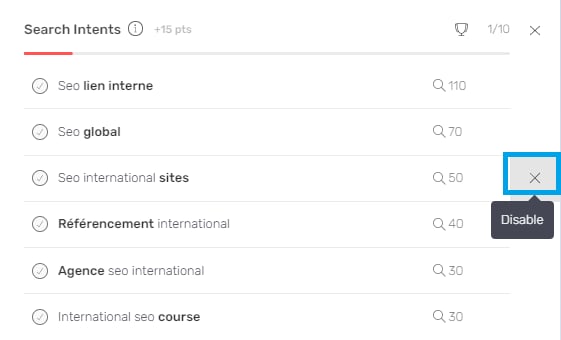
<h2>. If you wish, you can change this markup by highlighting your word and selecting 1 for <h1>, 2 for <h2>…
Starting with a blank page? The Search Intents and Questions sections help you build your writing plan. Click on the + each time a topic interests you, to add it to your blank page. The more related terms and search intents you cover, the more your content score will evolve, and the more relevant, deep and efficient your content will be.
Heatmap: how to interpret it?
By clicking on the cup, discover the highly sought-after topics by the audience and that your competitors are covering in particular.
Tips
Be sure to organize the Search Intents with the html title tags. The Hn tags must be placed in a certain order: the H1 is your first title, the tag should only be used once, at the top of the page. The following title levels can be more numerous, and allow you to hierarchize the information.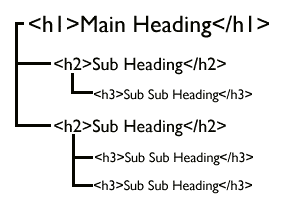 They should be nested to indicate levels of depth of information, as in the summary of a long book. For example, in the structure below, the h3 subheads allow you to subdivide the subject matter addressed by the h2 subhead:
<h2>How to handle the SEO optimization of your international content?</h2>
<h3>Meet your local audience expectations</h3>
<h3>Uncover the strategy of your local SEO competitors</h3>
<h3>Detect new SEO opportunities</h3>
<h2>How to organize SEO content production internationally?</h2>
…
SEO Questions
-
Can my H1 and my title be similar?
-
Can I use my focus keyword in several Hn?