

 Home
Home Getting Started
 Help Center
 Developer
 Status
- What is the visitor looking for in my content?
- Which question(s) should I answer?
- Which information should be addressed first, then second?
Content at least as long as the competition
Studies have shown that the content ranked in Google’s top positions is most often long-form content. And by long, we often mean more than 1,500 words. Internet users generally prefer to move around and scroll within a long, exhaustive page, rather than having to click on several links to access different short contents and find the desired information. During the analysis Semji performs after you’ve chosen your main keyword, Semji scans your competitors’ pages and calculates the length of their content. Based on this, our algorithm then tells you the recommended length for the content you are producing. Read our dedicated article to find out more about recommended length.Content that is well mapped internally
Links within an article are really important, they help :- users to navigate easily between contents, go deeper into a subject, keep the visitor on he website and easily give him what he’s looking for.
- Google to identify semantically related contents and thus to reinforce the authority of the site on this theme.
- Strategic linking facilitates the visits of Google bots on the pages and their indexing. You can then choose to increase the number of internal links to a particular page to give it more importance through Google’s eyes.
- Contextual linking suggests “similar content” to your user or content that could be of interest to them in the continuity of their search. You will then use semantic and thematic opportunities within your paragraphs to link to other related content.
Content integrated into topic cluster
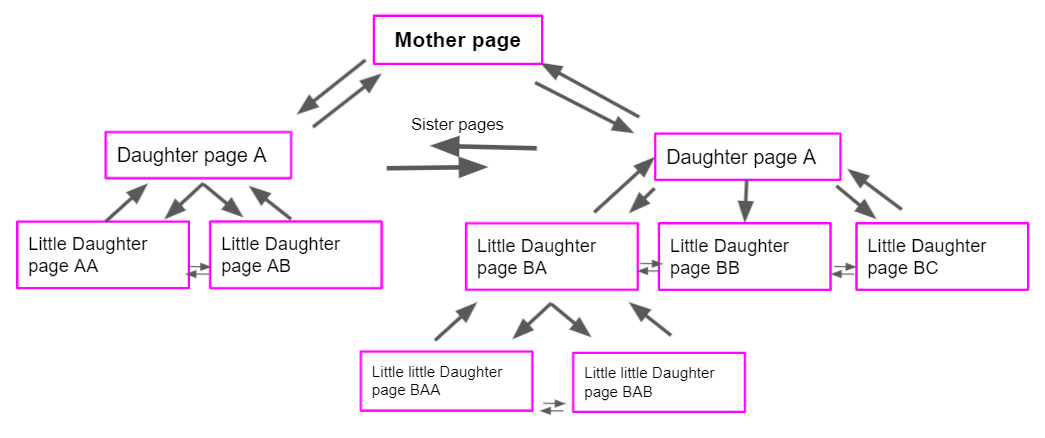
Alone in its corner, a content does not have much weight. Today in SEO, a good practice is to produce several contents around the same theme, and to create a logical tree structure between the contents, from the most general content to the most specific content. This is called the topic cluster. Here are the main steps:- Define the main theme on which to create a pillar page or “Mother page”. This page aims to rank for one of your generic keywords, defined earlier
Exemple : home insurance - Then define subtopics to identify other, more specific content topics. These will be your “Daughter pages”.
Example: tenant insurance, second home insurance, home insurance cancellation, home insurance change…
Regularly updated content
A website on a SERP (Search engine result page) is a bit like a boat on the open sea: there is wind, waves, and it moves. Normal, competitors are blowing ! To stay in the game, you have to adapt to the weather and often review your trajectory. In SEO, your watchword will be regular content updates. Semji is designed to make this simple through real-time recommendations based on Google’s ranking criteria and on your competitors. You can rework a content already produced with Semji Platform 6 months later: refresh the analysis with the “Update” button to get up-to-date recommendations.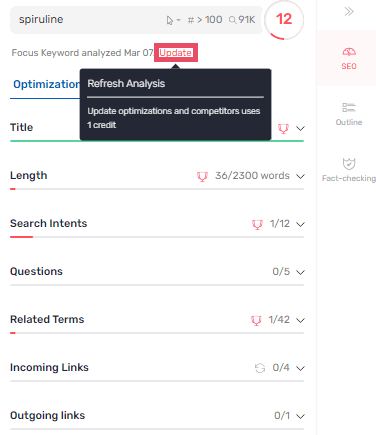
Remember: your competitors regularly update their content in order to move up in Google results. Don’t neglect this aspect ! Optimizing existing content can bring you as much profit as creating new content.Did you know that? Other criteria, that can be related to your site, have an impact on a content performance: the loading speed, the number of links referring to your content (backlinks)… Find out more !