

 Home
Home Getting Started
 Help Center
 Developer
 Status
Why import a url ?
Importing a url is a necessary step in the optimization process of an existing content, an Updated Content. Indeed, Semji Platform saves you time and provides you with optimization recommendations based on the analysis of your online content. By entering the url of your content, you allow Semji Platform to :- Access your data analysis tools such as Google Analytics, Search Console or AT Internet, provided you have connected them beforehand,
- Retrieve all the useful text of your web page, the editorial part of your HTML code that deserves optimization, in order to display it in the editor
- Offer you several possible Focus Keywords
- Analyze the SERP, once your Focus Keyword is selected, and calculate your Content Score
- The content you want to optimize has already been imported by Semji in the Opportunities
- The content you want to optimize is not an opportunity
- You need help or advice on which content to optimize.
1. Your content is an opportunity already detected and imported by Semji
When creating your workspace, Semji automatically imports several hundred pieces of content into the Pages > Opportunities tab. These are contents with a high chance of improving their SEO performance by following Semji’s recommendations. The platform displays a Priority Score that allows you to visualize the ratio editorial effort / gain for each of the imported contents.
2. The content you want to optimze is not an opportunity
If you have identified the url of the content you want to optimize with Semji, go to the “Online Content” tab and click on the “Import” button at the top right of your screen.
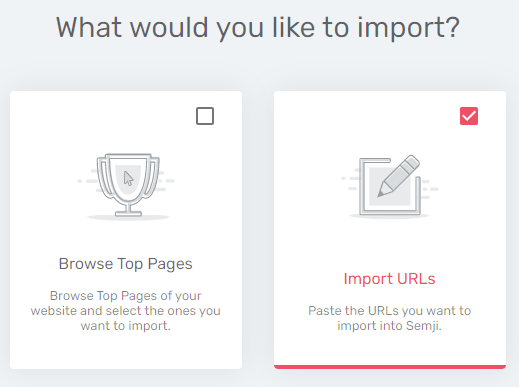

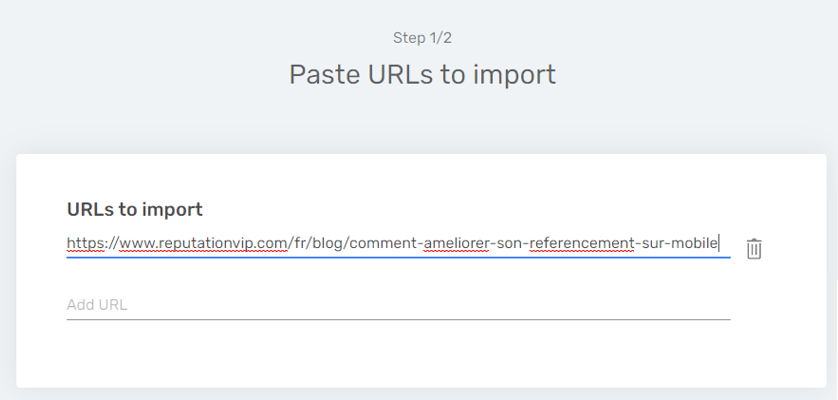


3. You need advice to choose the contents to be optimized: Semji assists you in the prioritization
The other option when importing existing urls is to let the Semji platform recommend pages to optimize, thanks to a prioritization score. To do this, you have to work hand in hand with the AI of the platform: first select a list of urls a little smaller to avoid the complete analysis of your site, and then let Semji apply its algorithm to get the result: prioritized urls by earning potential! In the Pages tab, click on the “Import” button in the upper right corner. Choose the “Browse Top Pages” option.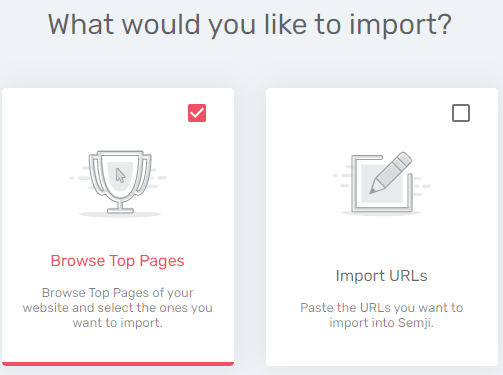

- These are your best urls, the ones that have generated the most clicks from the SERP during the last 30 days
- The clicks displayed are filtered: they are the clicks generated from the SERPs of the country on which your Semji workspace is set up (example: FR or EN)
- The proposed urls are sorted in descending order of clicks

Add filters to refine the proposed content
IMPORTANT : The “Add filter” button above the selection allows you to filter your list using different indicators.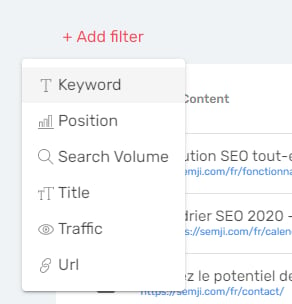
- The Keywords filter : select url for which the Focus Keyword contains or excludes some words.
- The Position filter: select urls whose position on the Focus Keyword defined by default corresponds to an exact value (e.g. 2nd position in the SERP) or to a range of values (between positions 3 and 10 in the SERP), is less than or greater than a given value (greater than 5 in the SERP)…
- The Search Volume filter : indicate here minimum, maximum or exact values to filter your url according to the search volume of the Focus Keyword defined by default
- The Title filter : select urls that include certain keywords in their title tag or on the contrary exclude it
- The Traffic filter : select url’s according to the traffic they already make, and define exact, minimum or maximum values, value ranges…
- The Url filter : select several urls that contain certain keywords in their slug or on the contrary exclude them
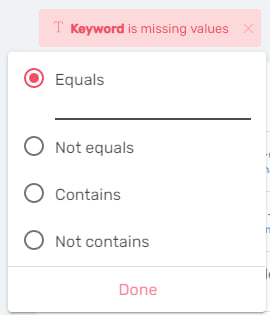
- that work with a keyword containing “shoe”.
- with a research volume of more than 300
- and which position this keyword between 4 and 10 in the SERP
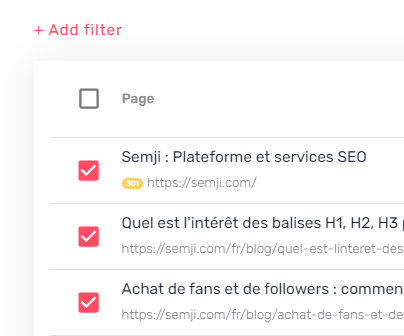



Imported content are displayed in the Page tab.
Once the analysis is completed, Semji assigns the prioritization score to all your urls and displays them in a decreasing order of priority. A visual gauge system allows you to differentiate the priority urls from those that are less important: